


 Yeah, I know many of you will think it is not real and it is true! I admit that. Nerina (and also the scary fish) are the splendid monstrous arts of Juan Cabana. For more photos of interesting mermaids and fish arts,


London: More than 94 per cent of the world's people are not protected by laws against smoking, leaving them exposed to the biggest cause of preventable death, the World Health Organisation said on Wednesday.
In a Global Tobacco Epidemic report the WHO said smoke-free policies were crucial to reducing the harm caused by second-hand smoke, which it said kills around 600,000 people prematurely each year and causes crippling, disfiguring illness and economic losses reaching tens of billions of dollars.
The report found some progress had been made, with 2.3 per cent of the world's population, or around 154 million people, newly covered by smoke-free laws in 2008. But it warned of many more early deaths if governments did not act quickly.
"The fact that more than 94 per cent of people remain unprotected by comprehensive smoke-free laws shows that much more work needs to be done," said the WHO's expert on non-communicable diseases, Ala Alwan.
Scientific evidence has unequivocally established that exposure to tobacco smoke causes death, disease and disability. Over the past four decades, smoking rates have fallen in rich places such as the United States, Japan and western Europe, but they are rising in much of the developing world.
The WHO said seven countries which includes Colombia, Djibouti, Guatemala, Mauritius, Panama, Turkey and Zambia were brought in comprehensive smoke-free laws in 2008, bringing the total to 17.
Tobacco is the leading preventable cause of death in the world, killing more than 5 million people a year. A report by the World Lung Foundation in August said smoking could kill a billion people this century if trends hold.
"Unless urgent action is taken to control the tobacco epidemic, the annual death toll could rise to 8 million by 2030," the WHO report said.
"More than 80 per cent of those premature deaths would occur in low- and middle-income countries - in other words, precisely where it is hardest to deflect and bear such tremendous losses."
The WHO report found that tobacco control remains severely underfunded, with 173 times as many dollars collected worldwide in tobacco taxes each year than are spent trying to get people to stop smoking.
Progress on implementing bans on tobacco advertising had stalled, it said, and progress on increasing tobacco tax had come to a halt, with nearly 95 per cent of people living in nations where tax is less than 75 per cent of the retail price.

 Alcatraz Island (sometimes informally referred to as simply Alcatraz or by its pop-culture name, The Rock) is a small island located in the middle of San Francisco Bay in California, United States. It served as a lighthouse, then a military fortification, then a military prison followed by a federal prison until 1963, when it became a national recreation area. The first European to discover the island was Juan de Ayala in 1775, who charted the San Francisco Bay and named the island "La Isla de los Alcatraces", which means "Island of the Pelicans".


Easter Island is one of the world's most isolated inhabited islands. It is 3,600 km (2,237 miles) west of continental Chile and 2,075 km (1,290 miles) east of Pitcairn. Nowdays, it is a Chilean-governed island, and is a world heritage site with much of the island protected by the Rapa Nui National Park.
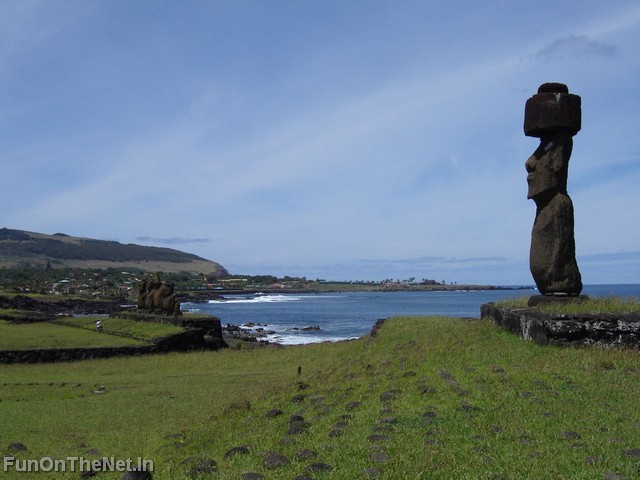

 First settled by a small party of Polynesians, Easter Island is one of the youngest inhabited territories on Earth, and for most of its history it was the most isolated inhabited territory on Earth. Its inhabitants the Rapanui have endured famines, epidemics, civil war, slave raids and colonialism; have seen their population crash on more than one occasion, and created a cultural legacy that has brought them fame out of all proportion to their numbers.

 The Principality of Sealand is an island and a micronation located on HM Fort Roughs, a former Maunsell Sea Fort located in the North Sea 10 km (six miles) off the coast of Suffolk, England, in what is claimed as territorial waters using a twelve-nautical-mile radius.
 Since 1967, the installation has been occupied by associates and family of Paddy Roy Bates, a former radio broadcaster and former British Army Major, who claims that it is a sovereign and independent state. Critics, as well as court rulings in the United States and in Germany, have claimed that Roughs Tower has always remained the property of the United Kingdom, a view that is disputed by the Bates family. The population of the facility rarely exceeds ten, and its habitable area is 550 m2 (5920 sq ft).


 Although now quite visible, the eruption lasted for much, much longer than the Ísleifur II would have been able to watch. After several days, the volcano had broken the water's surface, forming an island over 500 meters long and 45 meters tall. Even though the rough tides of the North Atlantic might have soon eroded the new island away, it was named Surtsey, meaning 'Surtur's island' - Surtur (or Surtr) being a fire giant of Norse mythology. The island proved to be tenacious, however. The eruption was ongoing and Surtsey increased in size more quickly than the ocean could wear it down. In the meantime two other nearby volcanic eruptions produced the beginnings of islands, but neither lasted very long. By April 1964, though, the most violent parts of the eruption were over and Surtsey remained.
 Gunkanjima is one among 505 uninhabited islands in the Nagasaki Prefecture about 15 kilometers from Nagasaki itself. The island was populated from 1887 to 1974 as a coal mining facility. The island's most notable features are the abandoned concrete buildings and the sea wall surrounding it. It is known for its coal mines and their operation during the industrialization of Japan. Mitsubishi bought the island in 1890 and began the project, the aim of which was retrieving coal from the bottom of the sea. They built Japan's first large concrete building, a block of apartments in 1916 to accommodate their burgeoning ranks of workers, and to protect against typhoon destruction.
 Gunkanjima is one among 505 uninhabited islands in the Nagasaki Prefecture about 15 kilometers from Nagasaki itself. The island was populated from 1887 to 1974 as a coal mining facility. The island's most notable features are the abandoned concrete buildings and the sea wall surrounding it. It is known for its coal mines and their operation during the industrialization of Japan. Mitsubishi bought the island in 1890 and began the project, the aim of which was retrieving coal from the bottom of the sea. They built Japan's first large concrete building, a block of apartments in 1916 to accommodate their burgeoning ranks of workers, and to protect against typhoon destruction.


